|
|
INDEX
People
Abravanel,
Don Isaac
Berg, Gertude (Molly Goldberg)
Berg, Moe
Berle, Milton
Berlin, Irving
Bernstein, Leonard
Brandeis, Louis D.
Cardozo, Benjamin
Einstein, Albert
Elion, Gertrude
Frankel,Jacob
Gershwin, George
Ginsburg, Ruth Bader
Gompers, Samuel
Goode, Alexander
Goodman, Benny
Gratz, Rebecca
Greenberg, Hank
Hillman, Sidney
Hoffman, Jeffrey
Houdini, Harry
Jefferson, Thomas
Karpeles,
Leopold
Lamarr, Hedy
Lazarus, Emma
Lehman, Herbert H.
Levy, Asser
Levy, Uriah P.
Magnes, Judah L.
Meir, Golda
Miller, Arthur
Myerson, Bess
Noah, Mordecai.
Ochs, Adolph
Pulitzer, Joseph
Resnik, Judith
Rose, Ernestine
Rosenthal, Robert
Ross, Barney
Salk, Jonas
Salomon, Haym
Santangel, Luis de
Sarnoff, David
Schick, Bela
Seixas, Gershom M.
Singer, Isaac B.
Stern, Isaac
Straus, Isidor & Ida
Strauss, Levi
Streisand, Barbra
Szold, Henrietta
Torres, Dara
Torres, Luis de
Touro, Judah
Wacks, Mel
Wald, Lillian
Washington, George
Wiesel, Elie
Wise, Isaac Mayer
Zacuto, Abraham
|
 |
|
|
|
|
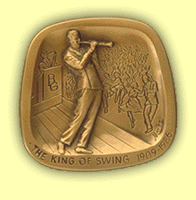
| Medal
by Marika Somogyi (1989), Benny Goodman, The King of Swing
. |
Benny Goodman
(1909-1986)
Benjamin
David Goodman grew up in a tough Chicago ghetto. His father took
Benny and two brothers to a local synagogue, where they received
musical instruments and lessons. Benny later studied with Franz
Shoepp, a clarinetist in the Chicago Symphony, which undoubtedly
accounts for his love of classical music.
Benny Goodman
made history at the Palomar Ballroom in Los Angeles on August
21, 1935, when the crowd of jumping, cheering youngsters surrounded
the bandstand during a swinging arrangement of Sugar Foot Stomp
... and the Swing Era was born! History was made again in March,
1937 when more than 21,000 people jammed their way into the New
York Paramount Theater to bounce in their seats and dance in the
aisles to the Benny Goodman Band. And his 1938 Carnegie Hall Jazz
Concert has earned an honored place in America's musical folklore.
Less known
is that the Benny Goodman Quartet, featuring Gene Krupa on drums,
Teddy Wilson on piano, and vibraphonist Lionel Hampton, made the
first dent in the color barrier that had until then kept bands
all white or all black. Hamptn has said that "the Benny Goodman
Quartet was the forerunner of getting Jackie Robinson into baseball."
Goodman
was equally at home playing Mozart with the Boston Symphony or
jamming at Harlem's Savoy Ballroom. Bartok dedicated his clarinet
trio "Contrasts" to Benny Goodman in 1938; later Goodman commissioned
Aaron Copeland's Concerto for Clarinet and String Orchestra in
1947, and Morton Gould's Derivations for Clarinet and Band in
1955. Benny Goodman was also a composer, having co-written standards
such as Stompin' at the Savoy and Swingtime in the Rockies.
Benny Goodman
was elected to the faculties of the Juilliard School of Music
and Boston University. In 1962, when "The King of Swing" made
a successful tour of the Soviet Union, one newspaper reporter
quipped that "Khrushev would trade three Sputniks for a Russian
Benny Goodman!"
"The Big
Broadcast of 1937" was the first of a long list of movies in which
Goodman appeared, and of course he supplied all of the clarinet
solos for the 1956 hit "The Benny Goodman Story" starring Steve
Allen. Anyone who was lucky enough to see Benny Goodman in person,
listen to him on the radio, or dance to his records, knows why
he was called "America's Number One Musician" by musicologist
Hal Davis.
Click
Here to Take Benny Goodman Quiz
Go to page: First Page Previous Page
Next Page
|


